

 English
 日本語
 Español
 عربى
 Deutsch
 Français
 Personal Wipes
 Baby Wipes
 Health Care & Medical Wipes
 Household Wipes
 Pet Wipes
 Industrial & Automotive Wipes
 Biodegradable Wipes
 Cotton Buds and Pads

Content
A diaper core that leaks at three in the morning is rarely a failure of the polymer itself. It is almost always a grade mismatch. Superabsorbent polymers sold into hygiene are specified by centrifuge retention capacity, absorbency under load, particle band and residual monomer, and a powder that posts 400 g/g in deionized water can still collapse to roughly 30 g/g under the 0.7 psi a sitting toddler applies. The same powder also decides how a converting hall is laid out, which is where SAP supply starts to touch wipe manufacturing.
Two figures drive most diaper-core decisions: centrifuge retention capacity of 30 to 45 g/g in 0.9% saline and absorbency under load of 20 to 30 g/g at 0.7 psi. Pure-water figures of 300 to 500 g/g describe the material, not the finished product.
What Superabsorbent Polymers Are and Are Not
Superabsorbent polymers are lightly crosslinked polyelectrolyte networks that swell with water-based liquids and hold them without dissolving.
A superabsorbent polymer (SAP) is a partially neutralized, lightly crosslinked polyacrylic acid network that can retain several hundred times its own mass in deionized water and roughly 30 to 45 times its mass in 0.9% saline while under load.
Three neighbouring materials get confused with SAP in sourcing conversations, and the mix-up usually shows up later as a performance complaint:
- Linear thickeners such as carbomer. They raise viscosity in a liquid formula. SAP is judged on how much fluid it keeps under pressure, not on how thick a solution becomes.
- Fluff pulp. Cellulose holds about 8 to 12 g/g through capillary action and wicks fast, which is why most absorbent cores still blend pulp with SAP rather than using powder alone.
- Hydrogel dressings. Same polymer family, different format and a completely different regulatory path, because a dressing is a finished device while SAP is an input granule.
How SAP Chemistry Becomes a Working Granule
Commercial SAP reaches its final specification through four stages, and each stage leaves a measurable fingerprint on the certificate of analysis.
- Neutralization. Acrylic acid is partly neutralized with sodium hydroxide, usually to 70 to 75 percent, so the network can ionize and swell. The neutralization degree moves absorbency and gel strength in opposite directions.
- Polymerization. Monomer is crosslinked with a difunctional or multifunctional acrylate. Gel polymerization in a belt reactor dominates hygiene grades, while solution and inverse-suspension routes give different particle shapes and dust profiles.
- Drying, grinding and sieving. The gel block is dried, crushed and milled, then cut to a 150 to 850 micron band for hygiene use. Fines below 150 micron are removed because they create dust and trigger gel blocking.
- Surface crosslinking and finishing. A shallow second crosslink at the particle surface raises absorbency under load, after which the product is coated, dedusted and released against the specification.
Gel blocking happens when the swollen outer shell of one particle fuses to its neighbour and seals fluid away from the core. In practice it is a particle-size and surface-treatment problem far more often than a polymer-quality problem.
SAP Grades: Matching the Polymer to the Product
SAP grades are separated less by base chemistry than by the balance of retention, gel strength, particle size and purity that the end product can tolerate.
| Grade family | CRC in saline (g/g) | AUL at 0.7 psi (g/g) | Particle band | Selection note |
| Baby diaper core | 32 to 42 | 22 to 28 | 150 to 500 micron | Highest gel strength, low fines |
| Adult incontinence | 30 to 40 | 24 to 30 | 150 to 710 micron | Faster uptake for larger void volumes |
| Feminine hygiene | 26 to 36 | 18 to 24 | 150 to 500 micron | Low extractables, tight fines control |
| Medical and wound care | 25 to 35 | Application specific | 100 to 300 micron | Device-grade documentation chain |
| Industrial and cable | 200 to 300 in pure water | Rarely quoted | 100 to 500 micron | Water-blocking, low swell under load |
| Agricultural and soil | 150 to 300 | Rarely quoted | 0.5 to 2 mm granules | Granule size suited to soil mixing |
- 30 to 45 g/g retention in saline
- Mature supply base, tight particle control
- Lowest cost per unit of absorbency
- Not readily biodegradable
- Starch, cellulose or chitosan grafts
- Bio-content claims of roughly 20 to 50 percent
- Lower absorbency under load, more gel blocking
- Colour, odour and batch variation to manage
Bio-based is not the same as biodegradable. A starch-grafted SAP can carry 40 percent biobased carbon and still fail a biodegradation test. Ask for the standard and the test report, not the adjective on the datasheet.
Reading the Absorbency Numbers
Absorbency values only compare when the method is stated, because free swell, centrifuge retention and absorbency under load describe three different behaviours of the same powder.
Indicative retention for one hygiene-grade polyacrylate across four test conditions.
A polymer quoted at 400 g/g in a brochure reads closer to 30 g/g in a diaper worn by a moving child. Specify the medium, the pressure and the retention time next to every figure you approve.
Where SAP Sits Next to Wipe Manufacturing
SAP and wet wipes are consumed in the same minute but handled in different rooms, and that separation is the real operational link between the two product categories.
A diaper change, an incontinence pad refresh and a wound dressing swap all begin with a wipe and end with an absorbent core. Buyers sourcing both categories tend to want one partner able to hold the two together, which is why wipe programmes and absorbent hygiene programmes so often travel in the same purchase order.
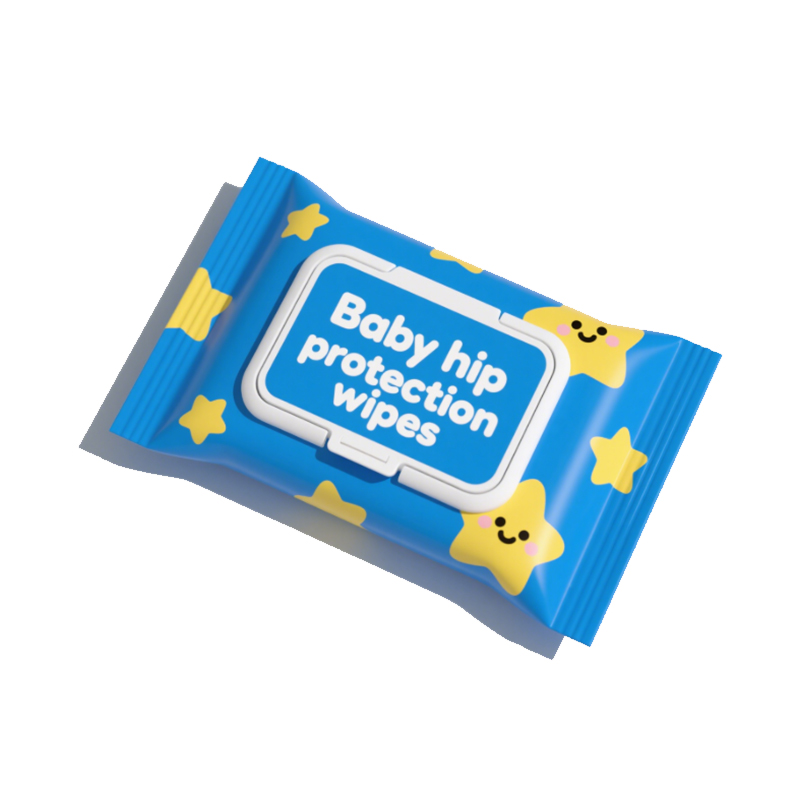 Baby Hip Protection Wet Wipes for Diaper ChangesSoft spunlace wipes with aloe and marigold, free of alcohol and fragrance, suited to baby cleanup within combined wipe and absorbent hygiene sourcing.View Product →
Inside a plant, the harder issue is dust. SAP fines travel on air, settle on packaging film and nonwoven, and can contaminate a lotion system several rooms away. Converters therefore keep powder handling under separate pressure zones with filtration, while the wipe line itself runs in a controlled environment such as a 100,000 class cleanroom with the documentation chain that medical-grade cleanroom production requires.
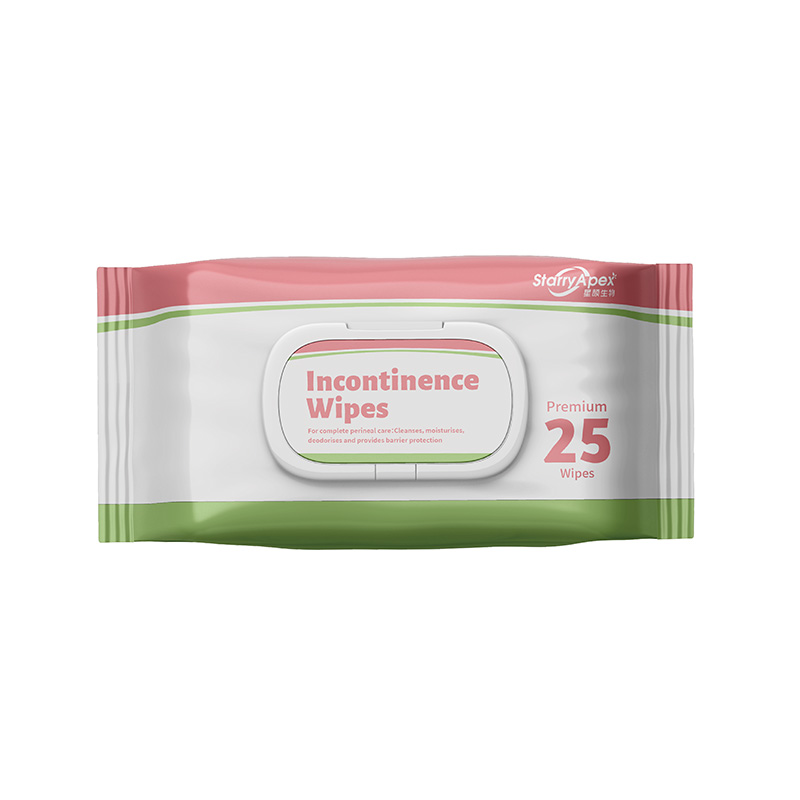 Custom Incontinence Wipes for Daily Personal CareUltra-soft, weakly acidic wipes with aloe and chamomile, individually packaged for portable cleanup; relevant where wipe lotion compatibility with absorbent hygiene must be checked.View Product →
Lotion chemistry is the second shared risk. A wipe lotion that shifts pH or carries a preservative system incompatible with the pad's adhesive or nonwoven can trigger irritation complaints that look like a polymer problem and are not. Our own technical notes on SAP chemistry and wet wipe sourcing cover how that compatibility is checked before a trial run.
When one supplier covers the wipe and understands the absorbent programme beside it, lotion pH, preservative choice and shelf-life testing become a single conversation rather than two, and that is exactly where most compatibility complaints begin.
Procurement Checklist Before You Approve a SAP Lot
A SAP order needs four things beyond grade and price: the test methods, the particle band, the purity limits and the packaging format.
- Methods named on the certificate. Centrifuge retention capacity, absorbency under load at a stated pressure, moisture, pH, particle size distribution and residual acrylic acid should each carry the test method beside the value.
- Particle band and fines content. Ask for the percentage below 150 micron, not just the sieve range. Dust affects worker exposure and adjacent converting lines in equal measure.
- Purity limits. Hygiene grades commonly sit at or below 300 ppm residual acrylic acid; medical programmes will ask for more detail on extractables and bioburden.
- Packaging and storage. Standard formats are 25 kg PE-lined bags and 500 to 1000 kg FIBCs. Check moisture barrier integrity and pallet condition, since SAP takes up humidity and clumps before it ever reaches the line.
- Supply consistency. Confirm lot-to-lot tolerance, retest period, and whether surface crosslinking is done in-house or bought in.
Because SAP is hygroscopic, a pallet stored beside a dock door can fail incoming inspection without any supplier fault. Storage conditions belong in the contract, not only in the warehouse procedure.
Frequently Asked Questions
Do superabsorbent polymers dissolve in water?
No. The crosslinks hold the network together, so the polymer swells into a gel and can retain several hundred times its mass in pure water without dissolving or washing away.
Why does absorbency drop so sharply in urine?
Dissolved salts screen the charges along the polymer backbone, which collapses the osmotic pressure that drives swelling. Expect roughly one tenth of the pure-water figure in 0.9% saline or synthetic urine.
Are superabsorbent polymers biodegradable?
Standard sodium polyacrylate SAP is not readily biodegradable. Bio-based and biodegradable variants exist, but they generally trade absorbency under load, whiteness and cost against the environmental claim.
Is SAP the same material as the gel in a hydrogel dressing?
It belongs to the same polymer family but takes a different format and follows a different regulatory path. A dressing is a finished, sterile device; SAP is an input granule specified by retention, load and purity.

