

 English
 日本語
 Español
 عربى
 Deutsch
 Français
 Personal Wipes
 Baby Wipes
 Health Care & Medical Wipes
 Household Wipes
 Pet Wipes
 Industrial & Automotive Wipes
 Biodegradable Wipes
 Cotton Buds and Pads

Content
SAP super absorbent polymer procurement is a performance-matching job, not a commodity price check. The same white powder can behave very differently when the fluid contains salts, when the absorbent core is compressed, or when the production line runs at high speed.
What SAP Super Absorbent Polymer Actually Does
SAP super absorbent polymer is a lightly cross-linked sodium polyacrylate material that turns aqueous liquid into a gel and holds it under pressure. It does not simply soak up water like a sponge; it chemically binds water inside a polymer network.
For buyers, the useful comparison starts with the fluid and the pressure. Urine, wound exudate, industrial spill liquids, and cable moisture all contain different dissolved solids. Those dissolved solids reduce the absorbency of most SAP grades, so water-based demo numbers can overstate real capacity.
The buying lesson is simple: ask for saline absorption and absorption under load at the pressure your product will see. A water swell number alone is a screening tool, not an approval test.
| Metric | What it reveals |
| Free swell, g/g | Basic absorption capacity; useful for screening but easy to overvalue. |
| Saline absorption, 0.9% NaCl | Closer to urine and body fluid conditions; better for apples-to-apples comparison. |
| AUL at 0.3-0.9 psi | How much liquid stays locked in when the gel is compressed. |
| Gel strength and permeability | Flow behavior inside a thick absorbent core and resistance to gel blocking. |
| Residual monomer | Safety and regulatory review for skin-contact or medical applications. |
| Particle size distribution | Dust, feeding behavior, dispersion, and consistency on the production line. |
How SAP Works: Cross-Linking, Gel Strength, and Limits
A SAP particle works because its polymer chains are cross-linked into a three-dimensional network. The network swells with water but does not dissolve, and the balance between swelling and structural strength determines where the grade can be used.
Cross-link density is the main design lever. Higher cross-linking usually gives stronger gel and better absorption under load, but lower free swell. Lower cross-linking can raise free swell, yet the gel may deform or block flow under pressure. Neutralization, particle size, surface treatment, and drying conditions also shift performance.
Higher cross-link density
- Stronger gel under compression
- Better absorption under load
- Lower free-swell capacity
- Useful in thin cores and high-pressure formats
Lower cross-link density
- Higher free-swell capacity
- Faster initial uptake in some formats
- Higher risk of gel deformation
- Needs careful testing in saline and under load
SAP Grades and Selection Matrix
SAP grades are usually selected by form, absorption profile, particle size, and the absorbent structure they will enter, not by a single absorbency number.
| Grade form | Typical use | Buyer check |
| Powder or granular sodium polyacrylate | Baby diapers, adult incontinence pads, spill control | Saline absorption, dust level, particle size |
| Surface-crosslinked SAP | Thin absorbent cores with high pressure | AUL, permeability, gel blocking risk |
| SAP fiber or nonwoven SAP | Cable wrap, food pads, thin absorbent layers | Uniformity, retention, converting compatibility |
| Composite SAP sheet | Medical pads, transport protection, packaging | Seal strength, swelling control, shelf life |
| Bio-based or biodegradable SAP | Sustainability-led absorbent products | Certification, actual degradation conditions, performance |
Grade names are less important than test conditions. Require the supplier to state saline concentration, sieve fraction, soak time, and pressure for every absorption claim.
Absorbent product design also depends on the carrier substrate. The same logic used in nonwoven fabric and wet-wipe substrate selection applies to SAP composites: fiber type, loft, and bonding affect how liquid reaches the polymer.
Quality Checks Before You Approve a SAP Lot
A SAP approval should combine certificate review with independent bench tests, because supplier datasheets rarely use the same test conditions.
- Request the CoA and SDS, then confirm residual monomer, moisture, pH, and heavy-metal limits.
- Test saline absorption in 0.9% NaCl with the same sieve fraction and soak time for every sample.
- Run absorption under load at the pressure closest to your end use, not only at a standard low pressure.
- Check particle size, dust, flow, and dispersion on the actual production line or a representative pilot line.
- Hold retain samples and repeat the same tests across at least three lots before full approval.
Do not compare SAP grades from free-swell demos alone. A 10% difference in saline absorption can matter more than a 100 g/g difference in deionized water.
Scale-up risk often appears as dust, feeding inconsistency, or gel blocking after the first production run. Build those checks into the approval plan rather than treating them as post-launch issues.
Where SAP Is Used, and What It Means for Adjacent Wipe Products
SAP is used mainly in absorbent hygiene, medical, industrial, and packaging applications where liquid must be locked into a gel rather than merely wiped away.
- Baby diapers, adult incontinence products, and feminine care pads
- Wound dressings, medical pads, and fluid-control layers
- Industrial spill socks, mats, and transport protection
- Cable water-blocking tape and moisture-control packaging
- Food pads and absorbent trays for meat, fish, and produce
In incontinence care, SAP pads handle bulk fluid while incontinence wipes handle skin cleaning between changes. The two product types are complementary, and buyers often source both for the same care program.
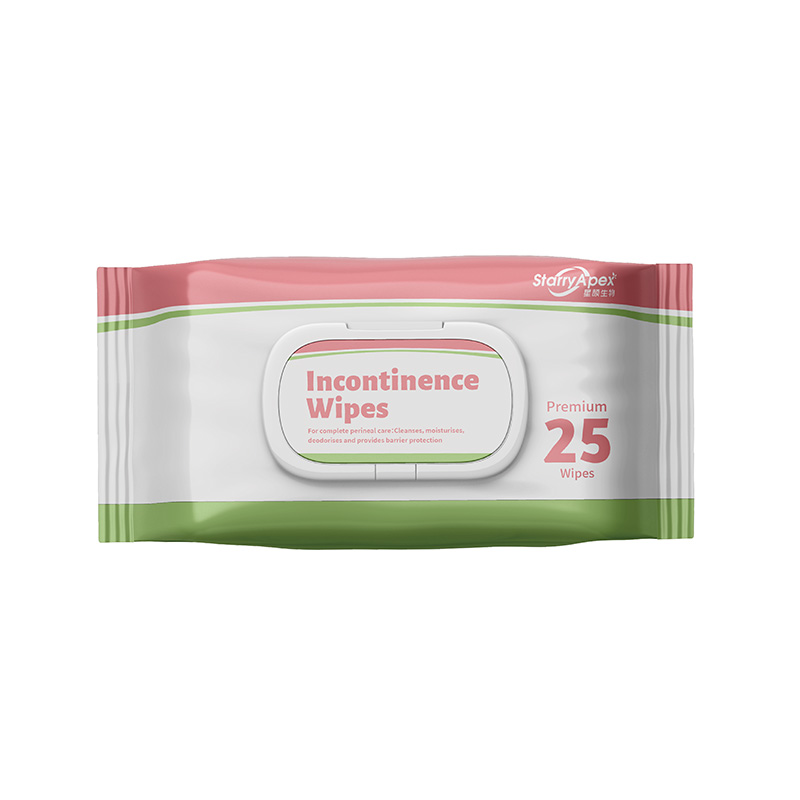 Custom Incontinence Wipes for Daily CareCustomizable incontinence wipes with soft non-woven fabric and mild cleansing solution, suited to daily care alongside SAP pads.View Product →
In industrial spill response, SAP socks or mats absorb the bulk liquid, while industrial wipes handle surface residue and tool cleanup. Matching SAP capacity to the wipe format prevents over-specifying one part of the kit and under-specifying the other.
 Custom Industrial Wet Wipes for Spill CleanupTough customizable wipes for oil, resin, and adhesive residue, useful for surface cleanup after SAP socks absorb bulk spills.View Product →
Sourcing note: confirm chemical compatibility between the SAP, the absorbed liquid, and the wipe or substrate used nearby. A grade that works well in water-based fluids may be unsuitable for acidic, oily, or high-electrolyte liquids.
SAP Super Absorbent Polymer FAQ
The right SAP choice is the grade that meets your fluid, pressure, safety, and process requirements at the lowest total cost of use.
Ask for data, not demos. A supplier who can explain test conditions, lot variation, and scale-up limits is easier to qualify than one who only quotes a free-swell number.
What is the difference between SAP powder and SAP fiber?
SAP powder is the standard form for diaper cores, pads, and spill products. SAP fiber is finer and can be formed into nonwoven or cable-wrapping structures where uniform distribution matters more than high free swell.
How should a buyer compare SAP quotes fairly?
Compare quotes using the same saline test, AUL pressure, particle size range, residual monomer limit, and delivery basis. Then add freight, minimum order quantity, and line trial cost before choosing the lowest offer.
Does higher free swell always mean better performance?
No. High free swell can come with weaker gel strength, slower uptake, or poor performance under pressure. For diapers and medical pads, absorption under load and permeability are usually more important than a single water-swell figure.
What safety documents should I request?
Request the SDS, CoA, residual monomer data, heavy-metal limits, microbial limits where relevant, and food-contact or medical documentation if the application requires it. Keep approved lot samples for traceability.

